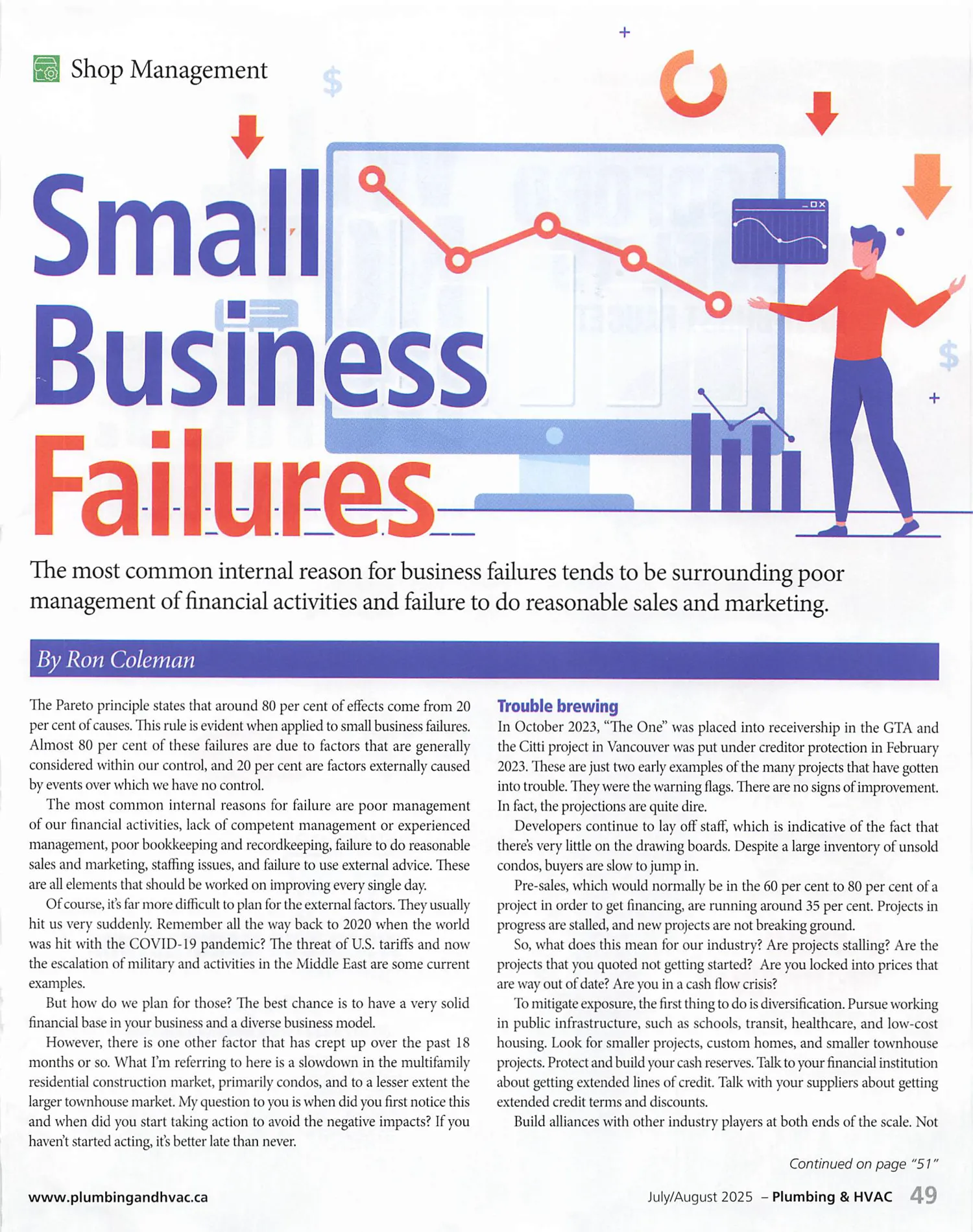
he most common internal reason for business failures tends to be surrounding poor management of financial activities and failure to do reasonable sales and marketing.
By Ron Coleman
The Pareto principle states that around 80 per cent of effects come from 20 per cent of causes. This rule is evidentwhen applied to small business failures. Almost 80 per cent of these failures are due to factors that are generally considered within our control, and 20 per cent are factors externally caused by events over which we have no control.
The most common internal reasons for failure are poor management of our financial activities, lack of competent management or experienced management, poor bookkeeping and recordkeeping, failure to do reasonable sales and marketing, staffing issues, and failure to use external advice. These are all elements that should be worked on improving every single day.
Of course, it’s far more difficult to plan for the external factors. They usually hit us very suddenly. Remember all the way back to 2020 when the world was hit with the COVID-19 pandemic? The threat of U.S. tariffs and now the escalation of military and activities in the Middle East are some current examples.
But how do we plan for those? The best chance is to have a very solid financial base in your business and a diverse business model.
However, there is one other factor that has crept up over the past 18 months or so. What I’m referring to here is a slowdown in the multifamily residential construction market, primarily condos, and to a lesser extent the larger townhouse market. My question to you is when did you first notice this and when did you start taking action to avoid the negative impacts? If you haven’t started acting, it’s better late than never.
Trouble brewing
In October 2023, “The One” was placed into receivership in the GTA and the Citti project in Vancouver was put under creditor protection in February 2023. These are just two early examples of the many projects that have gotten into trouble.They were the warning flags. There are no signs of improvement. In fact, the projections are quite dire.
Developers continue to lay off staff, which is indicative of the fact that there’s very little on the drawing boards. Despite a large inventory of unsold condos, buyers are slow to jump in.
Pre-sales, which would normally be in the 60 per cent to 80 per cent of a project in order to get financing, are running around 35 per cent. Projects in progress are stalled, and new projects are not breaking ground.
So, what does this mean for our industry? Are projects stalling? Are the projects that you quoted not getting started? Are you locked into prices that are way out of date? Are you in a cash flow crisis?
To mitigate exposure, the first thing to do is diversification. Pursue working in public infrastructure, such as schools, transit, healthcare, and low-cost housing. Look for smaller projects, custom homes, and smaller townhouse projects. Protect and build your cash reserves. Talk to your financial institution about getting extended lines of credit. Talk with your suppliers about getting extended credit terms and discounts.